Sunday, October 24, 2010

More Chicago


Here's the vestibule of the Auditorium, where I saw a performance of the Joffrey Ballet tonight. This wonderful concert hall was designed by Louis Sullivan and Dankmar Adler during the late 1880s.

Friday, October 22, 2010

Chicago, continued


And how's this for a modern take for a flatiron-shaped lot? This is Kohn Pedersen Fox's 333 West Wacker Drive, as seen from a boat on the Chicago River. Dig that curved mirror facade.

Thursday, October 21, 2010

Chicago

I'm in Chicago, where I gave a book talk yesterday at the Chicago Architecture Foundation--"The Flatiron, Chicago's gift to New York."
Are you listening, New York? If it weren't for Chicago we wouldn't have the Flatiron. The steel-frame skyscraper was invented in Chicago during the 1880s, where the men who built the Flatiron--the financier Harry Black, the architect Daniel Burnham, and the engineer George Fuller--learned everything they knew. (New Yorkers, for the record, called Chicago "a purposeless Hell.")

The Flatiron design has some specific Chicago elements, for example the curved corners. Today I walked around the Loop and noticed so many curvy-cornered buildings, like this one here. Doesn't it remind you of...the Flatiron? It's the Conway Building (now called the Burnham Center), built in 1915, and designed by Frederick Dinkelberg, the same architect from Burnham's firm who'd done the Flatiron fifteen years earlier. Guess he liked how his New York creation turned out.

Friday, July 30, 2010

After the Flatiron Man...what?

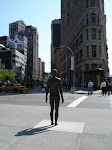
The statues of naked men by British sculptor Antony Gormley that are perched about Madison Square will depart on August 15. (Can't you just see them that day jumping off the various buildings, one by one, to line up behind Flatiron Man, and then boarding a bus which whisks them directly to JFK, where they will fly Virgin Atlantic back to London?) I'd gotten into the habit of looking for those guys every time I went down to the Flatiron during these past few months. Knowing they'll be soon gone, I already miss them. So I was happy to read in today's Times that another exhibit is in the works, courtesy of the Madison Square Park Conservancy. Click on the link below:

http://www.nytimes.com/2010/07/30/arts/design/30vogel.html?_r=1&scp=2&sq=madison%20square&st=cse

Thursday, July 29, 2010

The hottest July on record and so forth

This summer's torrid heat reminds me of July 1901, just before construction on the Flatiron Building began. It was so hot then that hundreds of people died. Horses, too; their carcasses lay about the streets. In Madison Park, people fought over the lovely wicker chairs-for-hire that an enterprising man who had recently arrived from England to seek his fortune had contracted with the city to place all over the parks, and in the choicest locations. Seemed like a great idea for New York, where everything was for sale, and anybody could get rich. In 1901, the economy was booming.


But the chair idea didn't fly. Because New Yorkers didn't like the idea of paying for sitting. Ha! Read more about this in my book.


In 1901, New York's economy was furiously expanding: skyscrapers were rising, subway tunnels were being dug out, and banks were getting stuffed with robber barons' money. New York is still arguably the world center of capital. But now so little gets manufactured here. Whereas in 1901 local factories were producing all manner of things that today are made overseas: construction supplies such as bricks, terra cotta, cast iron; office supplies--pens, pencils, typewriters, desks, chairs, glue; and everything having to do with the clothing trades, including thread, fabric, buttons, and the processing of ostrich feathers shipped from South Africa. Think of it, in all those old industrial lofts in the Flatiron District that are now upscale office space. In 1901, workers were toiling away there, producing tangible goods.

For an economy to thrive, it must produce something of value that others need to buy in order not just to live, but keep their own businesses running, and so forth and so forth. Obviously buying and selling just to get rich, i.e. trading in derivatives, doesn't cut it.

So how does the Flatiron District in 2010 compare to what it was 109 years ago? Yes, it is now glamorous, filled with the young partying set and establishments that cater to them. But we are in the midst of a recession, and there are plenty of vacancies. As for the skyline-altering One Madison Park, rising fifty glass-enclosed stories high, it is in foreclosure.

...and another mention

http://birnbaum.themorningnews.org/subject/alicesparbergalexiou/